

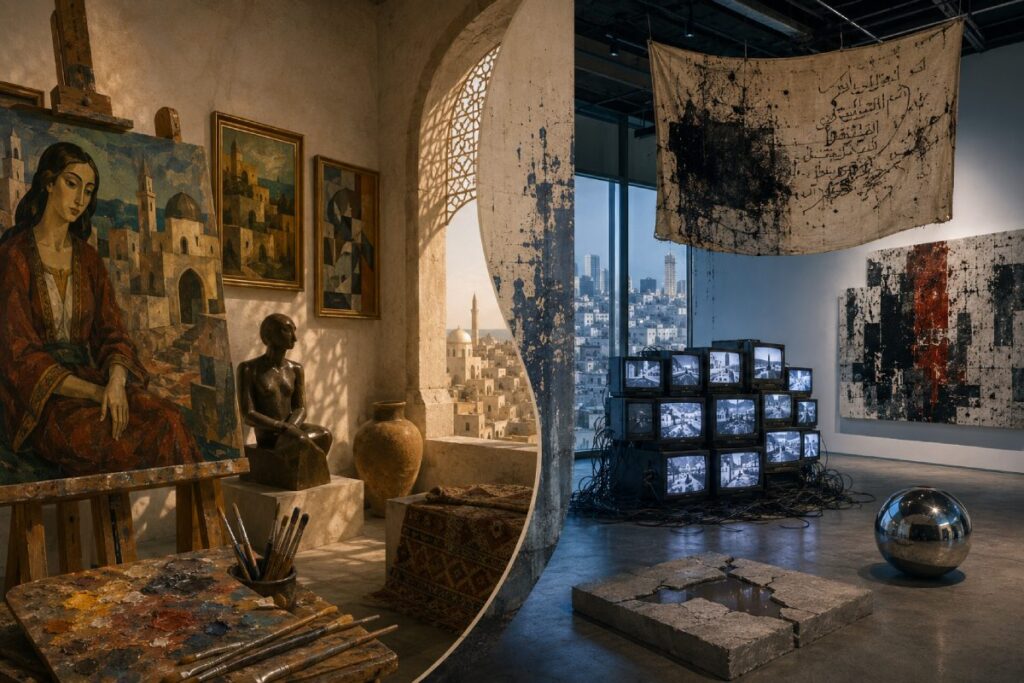
Modern Art vs. Contemporary Art: A Guide for Middle Eastern Art Collectors The artistic landscape of the Near East is a rich tapestry woven with historical resilience, cultural complexity, and aesthetic innovation. For the discerning collector or the passionate enthusiast, navigating the halls of a modern art gallery in Beirut or Amman is not merely a leisure activity, it is an immersion into the soul of a region. However, a fundamental question often lingers in the minds of those beginning their journey: what, in the Near East, is the actual difference between modern and contemporary art? At NESArt, we serve as a sanctuary for Near Eastern creativity, welcoming all who seek meaning through art. Our mission is dedicated to promoting and preserving this rich heritage, whether through our art advisory services or our rare artist management program that offers artists a space to create without the pressures of the commercial market. To build a collection of lasting value, one must first master the vocabulary of the industry. This guide provides an expert exploration into the Levant art history, clarifying the nuances between these two pivotal eras and explaining how they intersect. Defining the Timeline: Where in the Near East Modernism Ends and Contemporary Begins In the global discourse of fine arts, the timeline of modern art typically spans from the late 19th century roughly the 1860s up to the 1970s. This was an era defined by a radical break from traditional academic realism. Artists began to experiment with the subjectivity of experience, focusing on how they felt about the world rather than just how it appeared. However, when we examine modern art on the wider Middle Eastern context, the timeline shifts to align with regional socio-political milestones. The “Modernist Awakening” in the Arab world, or Nahda, found its footing artistically between the 1920s and the 1970s. This period was characterized by a search for a unifying cultural identity following the end of the Ottoman Empire and later the end of the colonial mandates. Lebanese artists like Paul Guiragossian and Saliba Doueihy fused Western techniques with local heritage, creating a distinct form of modern and contemporary art that reflected the region’s aspirations. So, what is contemporary art in the Near Eastern sense? While the Western contemporary art begins in the 1960s, in the Levant, the transition is often tethered to the outbreak of the Lebanese Civil War in 1975, as Lebanon was the intellectual hub of the Middle East. The “Post-War Generation” shifted away from the earnest, often utopian projects of the modernists toward more skeptical, conceptual, and research-based practices. Today, contemporary art is defined as the “art of the now,” produced by living artists who engage with current global and local issues. Aspect modern art (1930s–1970s) contemporary art (1975–Present) Primary Philosophy Subjective expression & national identity. Conceptual inquiry & social commentary. Core Mediums Oil on canvas, bronze, fine arts techniques. Multimedia, digital, installation, performance. Key Intent “How can I express my truth?” “What is truth and who decides?” Market Status Established “Blue-Chip” assets. Dynamic, speculative, and high-growth. Key Characteristics of Modern Near Eastern Masterpieces First it is a rejection of the past and a gateway to the future. The pioneers of modern art in the Middle East were often educated at prestigious institutions like the Ecole des Beaux-Arts in Paris, but they returned home to create something near new, merging the new western techniques with the local narratives that takes a singularity of expression to each part of the Middle East. A modern art gallery focused on the Near East will typically highlight works that showcase: A Fusion of Heritage (Istilhim al-turath): The use of traditional motifs, such as calligraphic forms or local landscapes, reimagined through the lens of Cubism, Surrealism, or Fauvism. Formal Innovation: A departure from three-dimensional perspective in favor of flattened planes, vibrant color palettes, and bold, expressive brushwork. National Narrative: Many types of modern art in this era were deeply tied to independence movements and the forging of a post-colonial identity. Artists like Mahmoud Said in Egypt or Shafic Abboud in Lebanon represented the pinnacle of this movement. Their work was earnest and often sought to capture the “spirit” of the people. At NESArt, we recognize these works as the foundation of regional art history, representing a “Golden Age” of creativity that continues to command record prices at international auctions. The Global Dialogue of Contemporary Art If modern art is a window into the artist’s soul, then contemporary art is a mirror held up to society. The contemporary art definition has expanded to include anything from digital collage to large-scale installations that disappear after three days. In Beirut, contemporary art emerged as a powerful medium for processing trauma and questioning historical narratives. A master of fine arts graduate today is less likely to be concerned with the “purity” of a painting and more interested in its “context.” For example, artists like Walid Raad or Akram Zaatari use archival documents and photography to explore the “latency” of the Civil War. Nowadays Contemporary art is no longer just about the Middle East; it is about the Middle East’s place in a globalized world. At NESArt, our artist management program supports this dialogue, providing mid-career and emerging practitioners with the space to venture beyond their usual parameters. This experimental nature is a hallmark of contemporary art, making it a “test bed” for new formats that blend art, technology, and social activism. Why the Distinction Matters for Valuation and Investment For the Middle Eastern art collector, the difference between modern and contemporary art is not just academic it is financial. The valuation of a piece depends heavily on its classification within art history. The Modern “Blue-Chip” Market The market for modern art is characterized by “rarity” and “provenance.” Because many countries in the region have faced periods of instability, sourcing authentic modern works with a clear history of ownership is difficult. This scarcity has driven prices to new heights. In 2025, modern Syrian master Louay Kayali realized …
 by Ucheed SEO
 Input your search keywords and press Enter.